
Car Detailing Lights | Types, Tips & Best Practices
Introduction
When it comes to professional car detailing, lighting is often the most overlooked tool in the workshop. The right car detailing lights can make the difference between a flawless finish and hidden imperfections. Proper illumination reveals scratches, swirl marks, paint defects, and dust particles that standard garage lighting simply cannot expose.
Whether you are running a busy detailing shop, restoring vehicles in a body shop, or working on your own car at home, dedicated detailing lights provide the clarity you need to achieve precision. From handheld inspection lamps to fixed hexagon LED lighting systems for full garage coverage, there are solutions designed for every space and every level of detailing expertise.
In this guide, we’ll explore why car detailing lights matter, the different types available, how to choose the right option for your needs, and what to consider before making a purchase. Along the way, we’ll also highlight professional lighting systems—such as Siltoll’s Car Care Lights—that are engineered specifically for detailing environments.
Why Car Detailing Lights Matter
Detailing is all about precision. Every swirl mark, paint defect, or missed spot can impact the final look of a vehicle. Unfortunately, most garages and workshops rely on standard overhead lighting, which is not designed to reveal fine imperfections on automotive paintwork.
Car detailing lights are engineered to replicate daylight conditions with high brightness, accurate color rendering (CRI), and optimal color temperature. This ensures that technicians can spot scratches, holograms, and uneven polishing before the car leaves the bay. Better visibility not only improves quality but also saves time by reducing the need for rework.
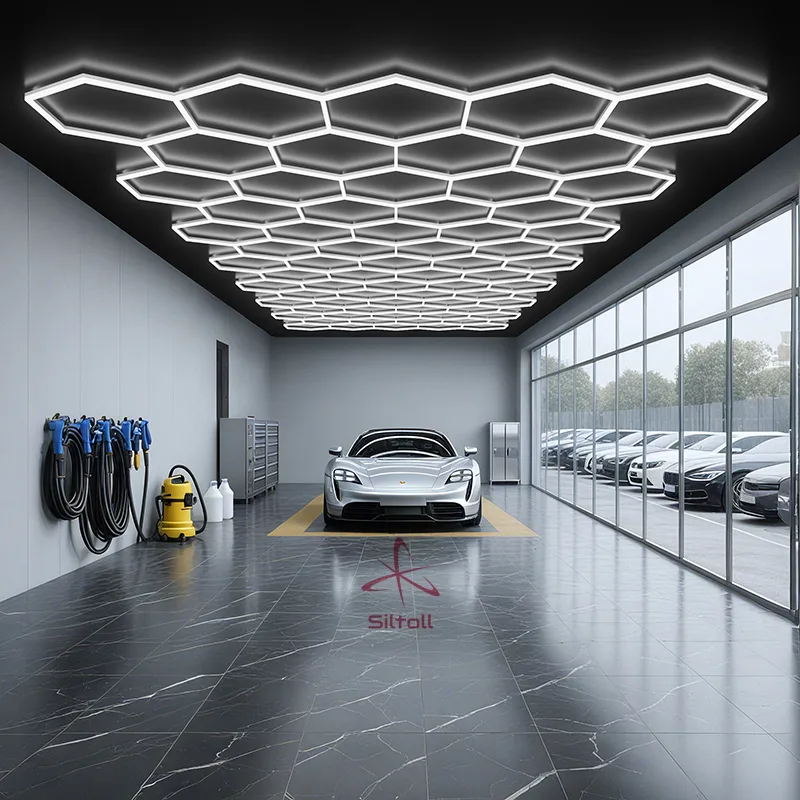
Another key advantage is consistency. Detailing lights create uniform illumination across the workspace, eliminating shadows and dark spots that make inspection difficult. For example, hexagon LED light systems provide broad, evenly distributed lighting that transforms an ordinary garage into a professional-grade detailing studio.
Ultimately, the right lighting setup enhances both efficiency and results. Whether you are polishing, washing, or inspecting, a dedicated detailing light ensures that you see exactly what your customers will see under natural daylight. For workshops looking to upgrade, Siltoll’s Car Care Lights deliver the brightness and coverage required for demanding detailing environments.
Types of Car Detailing Lights
Not all lighting solutions are created equal. Different detailing tasks require different levels of mobility, brightness, and coverage. Below are the most common types of car detailing lights, along with their typical uses:
1. Handheld Inspection Lights
Compact and portable, handheld lights are ideal for checking small areas up close. They allow technicians to move around the car, directing light exactly where it’s needed. This flexibility makes them a must-have for spotting swirl marks and paint defects during correction.
2. Panel and Strip Lights
Designed to cover a wider surface, panel and strip lights provide consistent illumination across larger areas. They are often mounted on walls or ceilings and are particularly useful in paint shops or dedicated detailing bays.
3. Tripod or Stand Lights
Mounted on adjustable stands, these lights can be positioned at different heights and angles. They are great for multi-purpose use, such as lighting up one side of a vehicle or focusing on lower panels that ceiling lights can’t reach.
4. Headlamps
For detailers who need both hands free, headlamps offer focused illumination directly in the line of sight. They’re especially handy for interior detailing or working in tight spaces.
5. Hexagon LED Lighting Systems
Increasingly popular in professional garages, hexagon LED lights combine design and performance. Their geometric patterns provide uniform coverage, reduce shadows, and create a high-end visual effect that elevates any detailing studio or car showroom. Unlike handheld solutions, these systems transform the entire workspace into a bright, color-accurate environment.
👉 For example, Siltoll’s Car Care Lights are modular hexagon setups available in different sizes, making them suitable for single-car bays, body shops, or even full showrooms.
How to Choose the Right Car Detailing Lights
With so many options available, selecting the right detailing lights comes down to matching performance specifications with your workspace requirements. Here are the most important factors to consider:
1. Brightness (Lumens)
High lumen output is critical for spotting paint defects and ensuring even illumination. Smaller spaces may only require moderate brightness, while large shops and showrooms benefit from high-output lighting systems.
- For compact bays or home garages, the SD02 Car Wash Kit provides 371W of balanced lighting.
- For professional body shops, the SD03 Auto Body Shop Kit delivers 774W, ideal for multi-purpose detailing areas.
2. Color Temperature (Kelvin)
Color temperature determines how “warm” or “cool” the light appears. For detailing, 5000K–6500K (daylight white) is recommended because it closely replicates natural daylight. This makes it easier to spot defects without color distortion.
- All of Siltoll’s Car Care Lights are tuned around ~6800K, optimized for car detailing accuracy.
3. Color Rendering Index (CRI)
CRI measures how accurately a light source reveals colors compared to natural sunlight. A CRI of 90 or above is essential for automotive work, especially for paint correction and color matching.
- Siltoll’s hexagon systems, such as the SD01 Border Kit, feature CRI ≥ 90 for true-to-life color inspection.
4. Space Size & Layout
The size of your workspace will often dictate which system is best:
- Single-car bay or small garage:SD01 Border Kit or SD02 Car Wash Kit
- Full-size workstation or body shop:SD03 Auto Body Shop Kit
- Showrooms and multi-bay setups:SD04 Showroom Kit or SD05 DIY Garage Kit
5. Installation & Flexibility
Consider how you’ll install and use the lights:
- Portable lights are useful for flexibility.
- Fixed hexagon LED arrays offer the most professional coverage and a striking design.
- For custom layouts, Siltoll supports CAD and 3D design services, ensuring the lighting system fits your exact bay or showroom dimensions.
👉 By balancing brightness, color accuracy, and workspace size, you can confidently choose a lighting system that enhances detailing quality and efficiency.
Who Needs Car Detailing Lights
Car detailing lights are not just for professional technicians—anyone who cares about the appearance and maintenance of vehicles can benefit from proper lighting. Different users, however, have different needs and expectations:
1. Professional Detailing Shops
For detailers handling multiple vehicles daily, consistent and accurate lighting is essential. Proper illumination helps ensure every customer receives the same high-quality finish, regardless of the weather or time of day.
2. Body and Paint Repair Facilities
In repair environments, technicians rely on strong, color-accurate light to detect paint imperfections, panel inconsistencies, and surface scratches. Adequate lighting reduces costly rework and speeds up the repair process.
3. Mobile Detailing Professionals
Those who provide on-site or mobile services need versatile lighting solutions that can adapt to different environments. Portable lights or modular systems allow them to deliver reliable results, even when working in poorly lit garages or outdoor spaces.
4. Car Showrooms and Dealerships
Showrooms benefit from lighting that not only aids in inspection but also enhances visual presentation. Bright, uniform light showcases vehicles in the best possible way, creating an appealing and professional atmosphere for customers.
5. Automotive Enthusiasts and DIY Users
Car owners who prefer to maintain or restore their vehicles at home also need proper lighting. Even for small garages, the right detailing lights improve visibility, reduce eye strain, and make detailing a more enjoyable hobby.
Tips & Best Practices for Using Car Detailing Lights
Even the best lighting systems need to be used correctly to deliver maximum results. Here are some practical tips and best practices to get the most out of your car detailing lights:
1. Position Lights at Multiple Angles
Defects like swirl marks or scratches are easier to spot when light strikes the surface from different directions. Use a combination of overhead and side lighting to reveal imperfections that a single light source might miss.
2. Avoid Direct Glare
High-intensity lights can cause discomfort or even temporary blindness if looked at directly. Always position lights so that they illuminate the vehicle without shining straight into your eyes.
3. Match Light Color Temperature to the Task
Daylight-white (around 5000K–6500K) is the most effective for paint correction, while warmer tones may be useful for interior work or creating a more comfortable environment.
4. Keep Surfaces Clean
Dust and dirt on light covers reduce brightness and can create uneven lighting. Wipe down your lamps and fixtures regularly to maintain maximum efficiency.
5. Use Consistent Lighting During the Entire Process
Switching between different light sources with varying brightness or color temperature can lead to missed defects. Try to work under the same lighting conditions throughout the detailing process.
6. Prioritize Safety and Stability
Ensure that mounted lights are securely installed, and portable units are placed on stable surfaces. For wired systems, check that all connections are safe and compliant with local electrical standards.
Recommended Products / Featured Selection
When it comes to upgrading your detailing space, different lighting setups are suited to different environments. Here are a few examples of popular configurations used across the industry:
1. Compact Garage or Single-Bay Setup
For small workspaces, compact light arrays or modular kits are the most efficient choice. They provide enough brightness to illuminate one vehicle without overwhelming the space.
2. Multi-Bay or Body Shop Layout
Larger repair shops often use extended LED arrays that ensure even coverage across multiple workstations. This helps technicians move between bays without losing consistency in lighting quality.
3. Showroom and Display Areas
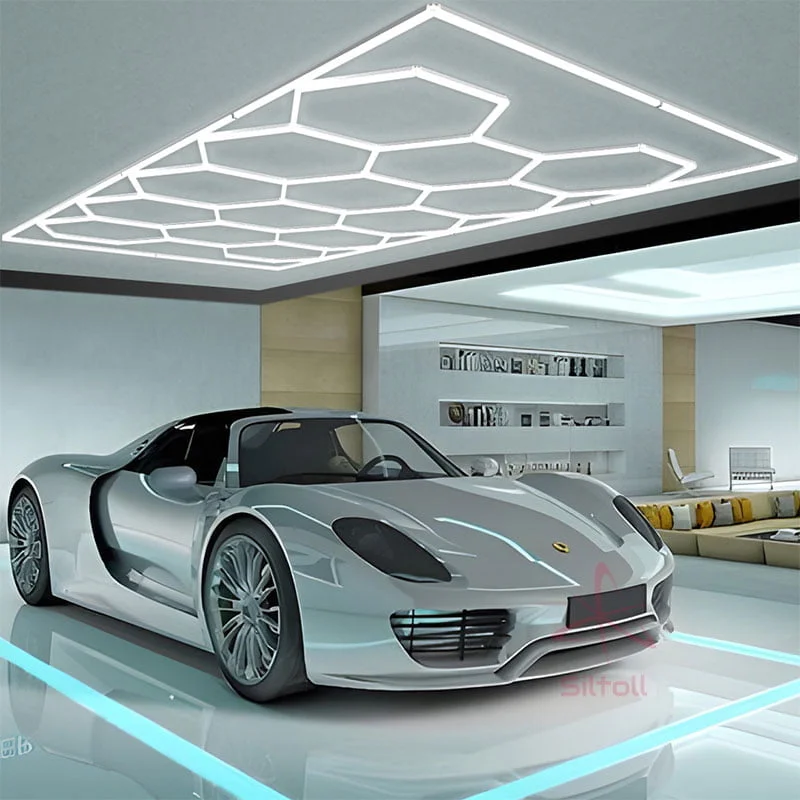
Lighting isn’t just functional—it’s also about presentation. Modern showrooms often use geometric light designs, such as hexagon arrays, to create a professional and eye-catching environment while maintaining optimal illumination.
4. DIY Enthusiast Spaces
For car owners who detail at home, lightweight and easy-to-install systems are ideal. These provide professional-grade brightness without requiring complex installation or heavy equipment.
💡 If you’re looking for ready-to-use setups, you can explore Siltoll’s Car Care Lights collection, which includes modular hexagon lighting systems designed for garages, body shops, and showrooms of different sizes.
FAQs
1. What’s the difference between regular LED lights and car detailing lights?
Standard LED lights are designed for general illumination, while car detailing lights are built to provide higher brightness, consistent color temperature, and a high Color Rendering Index (CRI). This makes it easier to see fine defects in paintwork that ordinary lighting would miss.
2. Which color temperature is best for car detailing?
Most professionals recommend a daylight-white range between 5000K and 6500K. This range closely simulates natural daylight, ensuring that scratches, swirl marks, and paint defects are clearly visible without distorting colors.
3. Do I need high CRI lights for detailing?
Yes. A CRI of 90 or above is considered ideal for detailing work. It ensures that colors appear accurate and helps technicians detect subtle variations in paint tone, which is critical for polishing and refinishing.
4. Are detailing lights suitable for home garages?
Absolutely. Even DIY car enthusiasts can benefit from professional-grade lighting. Proper illumination not only improves the detailing results but also makes the process more comfortable and reduces eye strain.
5. Are detailing lights difficult to install?
Most systems are straightforward to set up, especially modular or pre-assembled kits. For fixed ceiling-mounted arrays, basic tools and electrical knowledge are usually required. For safety, professional installation is recommended if wiring is involved.
6. Can detailing lights be customized?
Many modern detailing lights, especially modular systems, allow for customization in layout, size, and sometimes even color temperature. This flexibility makes them adaptable to different spaces, from compact garages to large showrooms.
Conclusion
Proper lighting is more than just a convenience—it’s a necessity for achieving flawless detailing results. From highlighting microscopic paint defects to creating a professional workspace that impresses customers, car detailing lights are an essential investment for anyone serious about automotive care.
Whether you’re running a busy detailing shop, managing a body repair facility, operating a showroom, or simply perfecting your own vehicle at home, the right lighting setup ensures precision, efficiency, and consistency.
💡 Ready to transform your workspace?
Explore the full range of professional-grade Car Care Lights and find a system that matches your space, workflow, and detailing goals.
No Comments